
Many blog post conclusions are where engagement goes to die. After delivering valuable insights, building trust, and demonstrating authority, they often end with a vague “that’s it” or a soft push to take action.
The excitement fades. The post loses momentum. And the intended action doesn’t happen because the ending lacks clarity or a direct route to the next step.
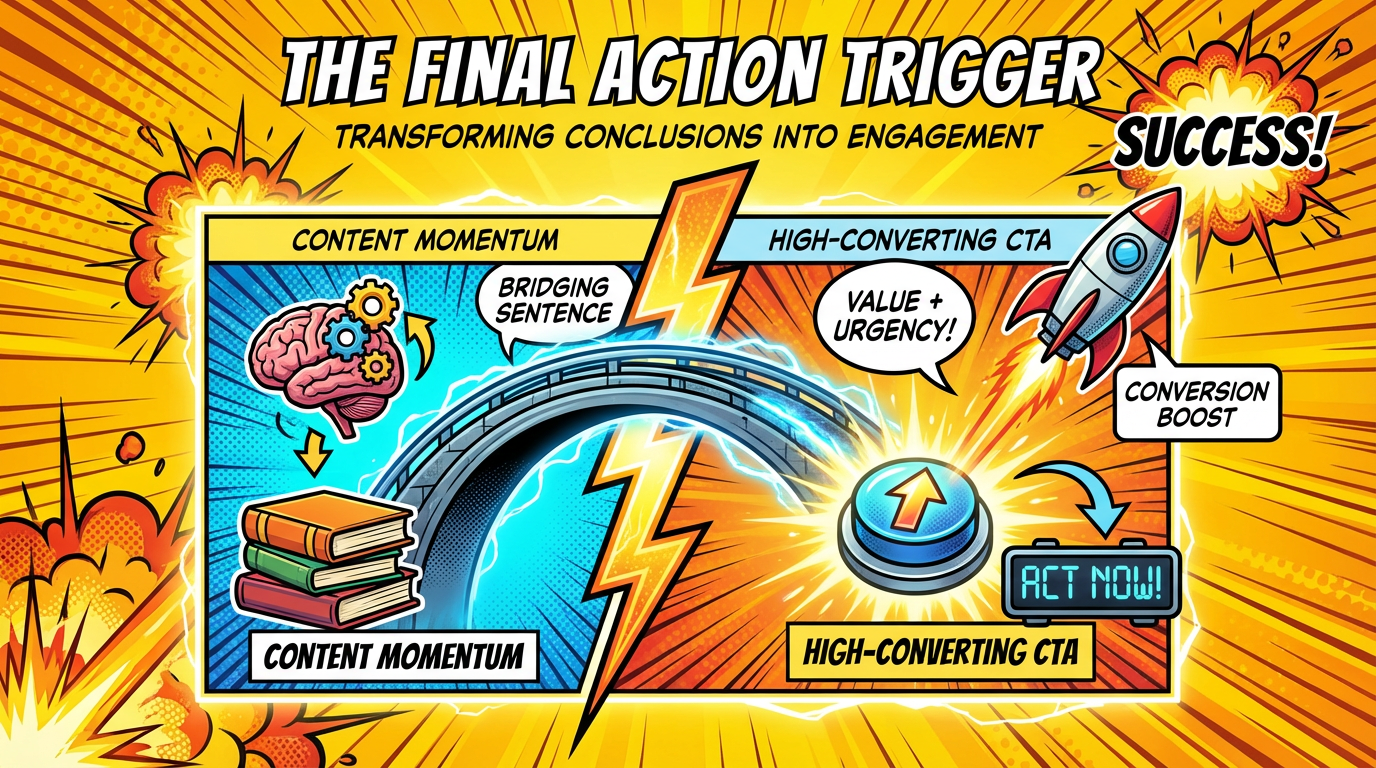
The Final Action Trigger technique changes this by transforming your content endings into clear, compelling calls to action that motivate readers. Not the generic “subscribe now” that they’ve tuned out, but real, contextually relevant prompts that link what they’ve learned to what they should do next. When your conclusion naturally follows from the content and provides a logical next move, conversion rates improve without seeming pushy.
This approach taps into psychology. When someone reaches the end of your post, they’re in a specific mental state—absorbing new information about a problem or topic.
They’re primed for action because momentum has been built. A well-crafted conclusion captures that energy and channels it toward a targeted response. A weak conclusion allows that momentum to fade away.
The Framework of an Effective Closing
An impactful conclusion consists of three parts, and none of them should simply recap what was discussed. Repetition kills momentum. The audience already read the content—they don’t need a condensed version. That’s filler, and they recognize it.
First is the bridging sentence. This links the main insight of your content to the specific action you want them to take. It answers “Now that I understand this, what should I do about it?” The bridge should feel like a smooth extension of the discussion, not a sudden sales pitch.
Second is the CTA itself. This is where you specify what exactly they should do—download a guide, sign up for a webinar, purchase a product, or visit another page. Focus on one clear, straightforward action, emphasizing what the reader gains rather than what you want from them.
Third is the element of urgency or motivation. This gives a reason to act immediately rather than leaving the page to drift in their bookmarks. It could be a deadline, potential consequences of delay, or a vivid picture of the benefits when they follow through now. It doesn’t need to be aggressive—just authentic and compelling.
PROMPT:
I need to craft a conclusion that turns my content into a high-converting CTA. Here are the details: Content topic: [WHAT YOUR POST/ARTICLE IS ABOUT] Target audience: [WHO THE READER IS] Main takeaway: [THE #1 THING THE READER LEARNED] Desired action: [WHAT YOU WANT THEM TO DO NEXT] What they get: [THE BENEFIT OF TAKING THAT ACTION] Offer details: [FREE DOWNLOAD / PAID PRODUCT / EMAIL SIGNUP / NEXT POST — specify if applicable] Please create a conclusion (3-4 short paragraphs) that: 1. Connects the core lesson to the next step with a bridging sentence 2. Frames the CTA in terms of the value it offers the reader 3. Adds a motivation element—why acting now matters 4. Ends with a direct, clear call to action Keep the tone casual and confident—no hard sell. No summary, just the transition.
Example in a Digital Marketing Context
Suppose you wrote about leveraging AI to produce lead magnets quickly. You want readers to download your free AI prompt template pack. Here’s how the conclusion might look.
PROMPT:
I need to craft a conclusion that turns my content into a high-converting CTA. Here are the details: Content topic: How to use AI to create lead magnets in under an hour Target audience: Solo online entrepreneurs who craft their own content and lead magnets Main takeaway: AI can simplify lead magnet creation if paired with the right prompts and structure Desired action: Download my free AI Prompt Template Pack for lead magnet creation What they get: 15 ready-to-use prompts guiding them through building checklists, cheat sheets, and mini-guides with AI Offer details: Free download with no credit card needed, just an email signup at mywebsite.com/prompt-pack Please write a conclusion (3-4 short paragraphs) that: 1. Links the main insight to the next step with a bridging sentence 2. Emphasizes the benefits of the download for the reader 3. Explains why acting now is advantageous 4. Ends with a clear, direct call to action Use a conversational, confident tone—no hard sales pitch or summaries.
AI might suggest: “You’ve got the structure and understand how to guide AI. Now, the only thing between you and your first AI-generated lead magnet is the prompts.”
Then it could follow with: “That’s exactly what the AI Prompt Template Pack is designed for—fifteen ready-made prompts that lead you step-by-step through creating checklists and guides. No more blank pages or prompt guesswork. Just open it, input your topic, and let AI do the rest.”
And finish with: “The marketers who act quickly are building their lists now while others are still planning. Download the free Prompt Template Pack at mywebsite.com/prompt-pack and start creating your AI-powered lead magnet today.”
This conclusion flows directly from the content, avoiding summaries or salesy language. It connects the new knowledge to a concrete next step, framing it as a natural extension of their current process.
Customizing for Different Calls to Action
Not every conclusion is about offering a freebie. Sometimes, you want readers to check out a paid product, read another article, or join your email list without a specific free resource. The structure remains the same—bridge, benefit-focused CTA, motivation, and clear instruction.
For a paid offer, connect their new understanding to how the product fills a gap. Highlight results over features. Emphasize the cost of not acting now or a limited-time discount to make decisions easier.
For a “read more” link, point out that the next piece dives deeper into the topic. Benefit is gaining exclusive insights, and motivation is curiosity about what comes next.
For an email subscription, relate it to ongoing value. Show that subscribing provides access to more expertise, with the benefit being what they’ll receive regularly. Motivation might be exclusivity or a special bonus.
The pattern remains: connect, frame for benefit, motivate, and instruct clearly. This ensures your content ends with a strong, action-oriented finish—making sure no conversion opportunities are missed.
Pro tip: Write your conclusion before developing the entire post. When you know the ending, the rest of your content can naturally lead to that final point, making the transition seamless and authentic.