
Subheadings often go undervalued in any content piece. Many creators see them as an afterthought—just some bold words to break up the text. But the truth is, subheadings carry a lot more weight, whether that’s obvious at first glance or not.
They steer your audience through the content, help keep casual scanners engaged, and clarify to search engines what your post truly covers. Yet, most subheadings tend to be dull and uninspiring.
The Subheading Strategy hack leverages AI to craft subheadings that successfully fulfill their purpose. Not the plain, predictable types AI often defaults to—like “What Is Email Marketing” or “Benefits of Lead Magnets”—which are dull and easily ignored. Instead, you want subheadings that serve dual functions: organizing your content AND enticing curiosity so readers are motivated to continue reading.
Consider how most people consume digital content. They scan rapidly, scrolling from one subheading to the next, searching for the part that relates to them. If your subheadings are vague or generic, they’ll assume there’s nothing worthwhile here and move on. But if your subheadings promise specific, useful insights, scanners become engaged readers.
Weak vs. Strong Subheadings: What’s the Difference?
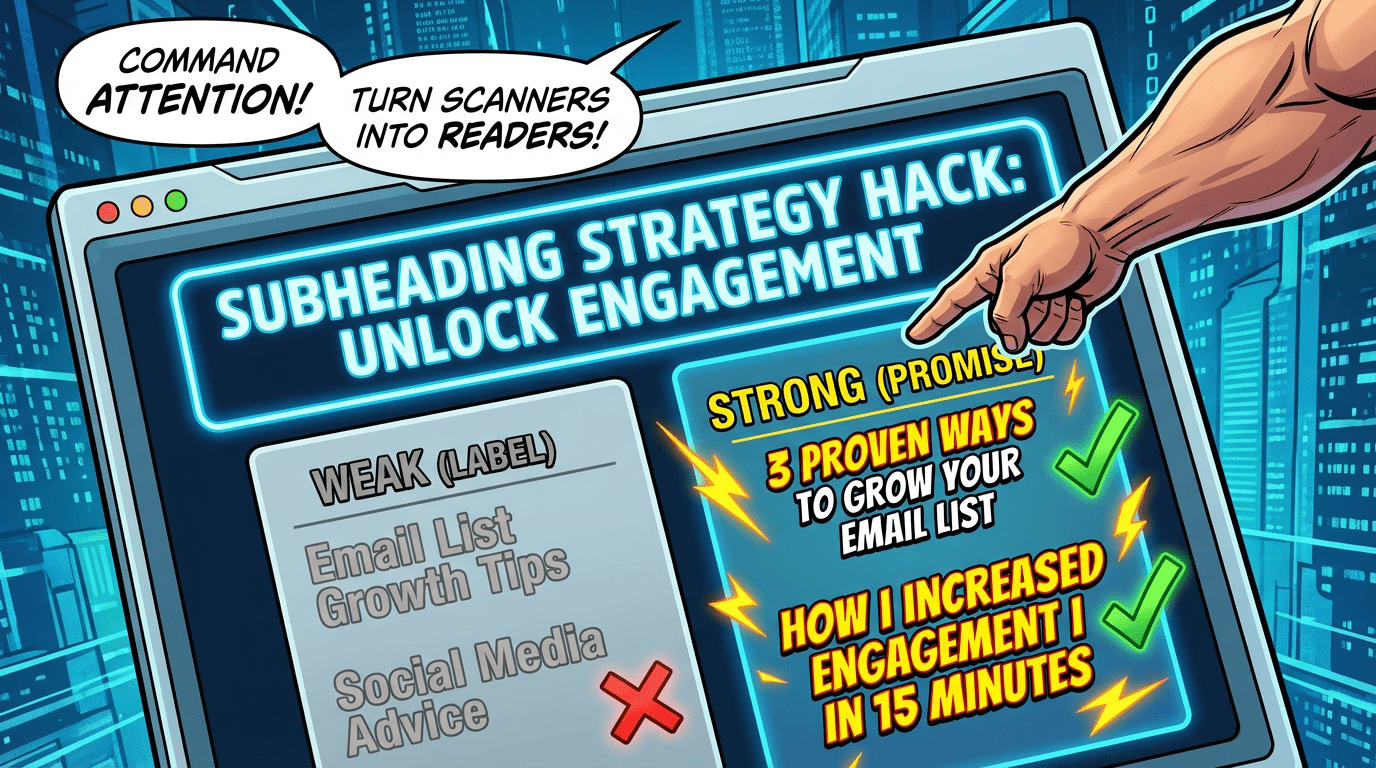
A weak subheading simply labels a section. A strong one sells the section’s value. The gap between the two is significant, and it takes very little extra effort to shift from a label to a compelling promise.
For example, a blog post about growing an email list might have a weak subheading like “Email List Growth Tips.” It states what the section is about but offers no compelling reason to read further. You could easily guess what’s inside without opening it.
A stronger version could be “3 Proven Ways to Grow Your Email List Without Running Ads.” Now, it clearly states the benefit and sparks curiosity—what are these three ways, and how can they work without paid traffic?
Another example. Weak: “Social Media Advice.” Strong: “How I Increased Engagement with a 15-Minute Daily Routine.” The first is just a label; the second promises something valuable and actionable. Every subheading should lean toward offering a promise rather than merely labeling the content.
AI often defaults to the label style—producing safe, corporate-sounding headers that readers tend to skip. The Subheading Strategy prompt corrects this by instructing AI to create subheadings that are worth reading, emphasizing the value they deliver.
PROMPT:
My content needs stronger subheadings. Here are the details: Topic: [YOUR TOPIC] Target audience: [WHO THIS IS FOR] Content type: [BLOG POST / GUIDE / EBOOK / EMAIL] Number of sections: [HOW MANY SUBHEADINGS NEEDED] For each section, here’s a brief about what it covers: 1. [SECTION 1 OVERVIEW] 2. [SECTION 2 OVERVIEW] 3. [SECTION 3 OVERVIEW] (Add more if needed) Please generate 3 subheading options per section using these methods: Option A: Clear benefit or result for the reader Option B: Curiosity-driven—makes the reader want to learn more Option C: Action-focused—implying the reader will do something Avoid generic labels. Every subheading should give a reason to read that section.
Applying It to Real Content Creatio
Suppose you’re crafting a guide on launching digital products for your niche audience. You have four main sections planned, and they need subheadings that add value. Here’s how to craft your prompts.
PROMPT:
My content requires more compelling subheadings. Details prior: Topic: Launching your first digital product as a niche expert Target audience: Online entrepreneurs selling info products who want their debut piece Content type: Blog post Number of sections: 4 For each, a quick summary of what it covers: 1. Picking a product idea your audience already asks for 2. Choosing between an eBook, mini course, or template pack 3. Using AI to streamline content creation without losing quality 4. Building a simple sales page and delivery setup Please generate 3 subheading options for each based on: Benefit or outcome, curiosity, and action.
For the first section about selecting a topic, AI might suggest: Option A: “Identify a Product Idea Your Audience Is Ready to Buy” Option B: “The Simple Research Hack That Reveals Exactly What Your Audience Needs” Option C: “Scan Comments and DMs for a Hot Product Idea” These are far more engaging than “Choosing a Product Topic.” The stronger options give specifics, hint at a method, or promise a result, encouraging readers to keep reading.
Mix and match parts of these options if needed—start with strong raw material instead of trying to turn bland labels into something captivating. It’s all about starting with headers that genuinely do their job.
Making this a Staple in Your Content Workflow
The real win from this approach isn’t just in individual subheadings. It’s about training yourself to see and fix weak ones on the spot. Once you recognize the difference between a label and a promise, you’ll start catching and improving bland headings before publishing.
Apply this prompt every time you’re creating long-form content—blog posts, guides, ebooks, or sales pages. It takes a minute, but the options you get are almost always better than what you’d create when focusing on writing the body.
Use it retroactively, too. If your older content isn’t performing, pull its subheadings, feed them into AI with descriptions of each section, and generate stronger alternatives. Swapping out just a few can significantly boost engagement and time-on-page, turning casual skimmers into engaged readers.
Another idea: test headline effectiveness. If you can A/B test subheadings, compare benefit-driven versus curiosity-driven options. Track which keeps visitors longer and learn what resonates best with your audience. That insight applies across your entire content strategy.
The test is simple. Scan only your subheadings. If they make you want to explore the section, they’re effective. If not, run the hack, improve them, and give your readers a reason to stay hooked—whether they’re scanning or reading deeply.
Quick tip: After generating options, read the subheadings aloud in sequence. They should flow like a mini-story or logical outline, not just random clever phrases. Properly structured headers act as the skeleton of your content—and that skeleton should make sense even without the full body.