The opening two sentences of any piece of content hold more influence than the rest combined. It might sound dramatic, but the statistics support it. Most viewers decide within seconds whether they will continue reading or leave. Your initial hook either draws them in or causes them to bounce, and there’s no real middle ground here.
The Hook Creation Tool provides you with five distinct opening angles for any topic in roughly thirty seconds. Instead of staring at a blank screen, trying to craft that perfect first sentence, you let AI generate multiple options so you can choose the one that resonates most. It’s applicable for blog posts, emails, social media captions, sales pages, and practically anything else that needs to grab attention quickly.
What makes this different from simply asking AI to “write an introduction” is that when you request just one intro, AI typically offers its best guess at what you want. Sometimes it’s excellent, but often it’s quite plain. By asking for five hooks based on five specific frameworks, you get variety. And variety means options. Options give you the freedom to select the best one instead of settling for just one.
The Five Hook Frameworks
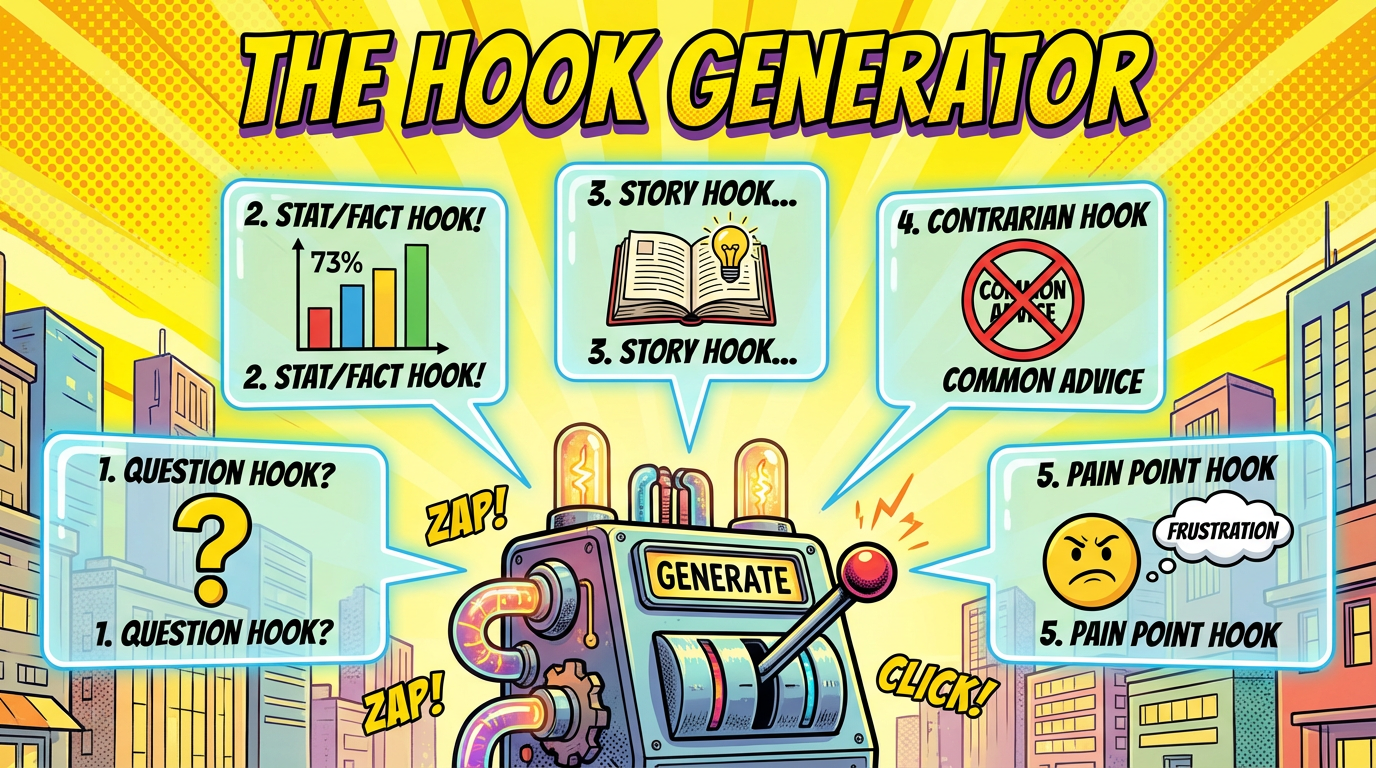
Most compelling hooks fall into one of several categories. The prompt you’ll use prompts AI to generate one of each, ensuring you always have a range of approaches to pick from. Here’s what each framework does.
The “Question Hook” begins with a question your audience is already pondering. It works because it establishes an immediate connection. The reader thinks “yes, I’ve wondered that too,” and keeps reading to discover the answer. The trick is making the question specific enough to feel personalized but not so broad that it seems generic.
The “Stat or Fact Hook” starts with a number or data point that stops scrollers in their tracks. For instance, “73% of email lists lose half their subscribers within the first three months” grabs attention since it’s concrete and slightly alarming. The statistic doesn’t need to be shocking, only specific enough to seem credible and interesting enough to seek more context.
The “Story Hook” places the reader into a brief, vivid scenario. Not a long story, just one or two sentences painting a picture. For example, “Last Tuesday at 2 AM, I deleted my entire email sequence and started over.” It sparks curiosity, prompting readers to want to know what happened next and why.
The “Contrarian Hook” challenges a common belief or widely accepted advice within your niche. It opens with a statement that disrupts expectations. This approach works especially well in saturated markets where many tips are recycled. For instance, “That content calendar everyone told you to create is actually slowing your progress.” It captures attention by turning conventional wisdom on its head.
The “Pain Point Hook” identifies a specific frustration your audience is experiencing. It’s direct and honest. Examples include “You’ve been posting daily for three months, but your engagement keeps dropping.” It resonates because it validates their struggles and makes them feel understood.
PROMPT:
I need 5 different opening hooks for a piece of content. Here are the details: Topic: [YOUR TOPIC] Target audience: [WHO THIS IS FOR] Content type: [BLOG POST / EMAIL / SOCIAL POST / SALES PAGE] Tone: [CONVERSATIONAL / PROFESSIONAL / EDGY / FRIENDLY] Please write 5 hooks, one for each of these frameworks: 1. Question Hook — start with a compelling question your audience is already asking 2. Stat/Fact Hook — start with a specific number or data point that creates curiosity 3. Story Hook — begin with a brief, descriptive scenario (1-2 sentences) 4. Contrarian Hook — challenge a common belief or advice in this market 5. Pain Point Hook — specify the exact frustration your audience is going throughEach hook should be 1-3 sentences long. Make them tailored to your audience, not generic.
Applying This to Your Niche Content
Suppose you’re in the online marketing space and writing a blog about creating a lead magnet funnel. Here’s how you’d complete the prompt and what you might get back.
PROMPT:
I need 5 different opening hooks for a piece of content. Here are the details: Topic: Building your first lead magnet funnel Target audience: Solo online marketers with traffic but no email list Content type: Blog post Tone: Conversational Please craft 5 hooks, each based on these frameworks: 1. Question Hook — start with a question your reader is contemplating 2. Stat/Fact Hook — include a specific number or data point that sparks curiosity 3. Story Hook — dive into a short, vivid scene (1-2 sentences) 4. Contrarian Hook — dispute a common belief or advice in this field 5. Pain Point Hook — pinpoint their current frustrationEach should be no longer than 1-3 sentences, tailored specifically to your audience, not generic.
AI might respond with a Question Hook like “What if every visitor to your site left you their email address?” The Stat Hook could be “The average website converts only 2-3% of visitors into subscribers, meaning 97% leave without signing up.” The Story Hook might start with “I saw 1,200 visitors hit my blog last month, yet none joined my email list because I didn’t have one.”
The Contrarian hook could state “Everyone tells you to focus on increasing traffic, but it’s pointless if you aren’t capturing any emails from the visitors you already have.” And the Pain Point Hook might be “You create content, get clicks, but have nothing to show for it—no list, no leads, no follow-up.”
Now you’ll have five diverse ways to kick off that blog post. Pick the one that fits your message best. Maybe the Pain Point Hook emphasizes urgency, or perhaps the Stat Hook provides numeric credibility.
Enhancing Your Hooks’ Effectiveness
Once you’ve selected your favorite hook, ask AI to expand it into a full introduction. Simply copy and paste the hook and prompt, “expand this into a 3-4 sentence opening paragraph that smoothly transitions into the main topic of [your topic].” This results in a professional, compelling intro based on a strong opening.
You can also reuse the other hooks for different purposes. For example, the Question Hook could be an eye-catching subject line for an email. The Contrarian hook might serve as a social media tease directing traffic. The Story hook could be the opening of a future email. Nothing should go to waste.
Another tactic is to run this prompt multiple times with varied audiences or tones. A beginner-friendly hook might not work as well for advanced marketers, and a casual tone may not suit a more formal brand. Generating several options ensures you have versatile content for different platforms and segments.
The big mistake many make with AI content starts at the very top. Weak openings mean readers often never see the valuable content that follows. The Hook Creation Tool guarantees five proven approaches in every run, so your content always kicks off with impact.
Pro tip: Keep a document organized with your best hooks by framework type. After some months, you’ll build a swipe file of effective openers to adapt. Over time, you’ll notice which types resonate most with your audience, revealing what drives engagement best.